
A Comprehensive Guide to the Legal Framework, Statutory Provisions, and Landmark Judgments Governing Partition of Ancestral Property in India
NEW DELHI: Property disputes within families are quite common in India, especially when it comes to ancestral property. Over generations, families often continue to use or occupy property without formally dividing it or maintaining clear records.
Problems usually begin when one member tries to sell the property, claim exclusive ownership, or when heirs start asserting their respective shares.
Under Hindu law, ancestral property creates a coparcenary, which means certain family members automatically acquire rights in the property by birth. Because multiple people have legal rights in the same property, disagreements frequently arise over shares, inheritance, or decisions taken by the family head regarding the property.
As a result, courts in India regularly deal with such disputes, examining family lineage, ownership records, and legal provisions to determine the rightful shares of each coparcener and ensure a fair division of the property.
To understand how these disputes arise and how the law addresses them, it is important to look at the legal framework governing ancestral property, the process of partition, and the common issues that typically lead to litigation.
What is Ancestral Property Under Indian Law?
Ancestral property refers to property inherited up to four generations of male lineage from a common ancestor without division. Under classical Hindu law, such property forms part of a Hindu Undivided Family (HUF) and creates a coparcenary among eligible members.
Unlike self-acquired property, which the owner can dispose of freely, ancestral property automatically confers rights upon coparceners.
The principal statute governing such rights is the Hindu Succession Act, 1956, particularly Section 6, which deals with the devolution of interest in coparcenary property.
Key Features of Ancestral Property
- Rights arise by birth, not by inheritance after death.
- Every coparcener has the right to demand partition.
- Shares fluctuate with births and deaths in the family.
- Property cannot be disposed of arbitrarily without considering the rights of other coparceners.
Who Has the Right to Seek Partition?
A partition suit can be initiated by any coparcener who seeks a separation of his or her share in the ancestral property.
Traditionally, coparceners included:
- Father (Karta of the HUF)
- Sons
- Grandsons
- Great-grandsons
Following the 2005 amendment to the Hindu Succession Act, daughters were also recognized as coparceners.
Relevant Judicial Interpretations
In Prakash v. Phulavati, the Supreme Court initially interpreted the amendment to mean that daughters could claim coparcenary rights only if the father was alive on the date the amendment took effect.
However, this interpretation was later clarified and expanded in Danamma v. Amar, and ultimately settled by the Supreme Court in Vineeta Sharma v. Rakesh Sharma, which affirmed that daughters possess coparcenary rights by birth.
Legal Process for Partition of Ancestral Property
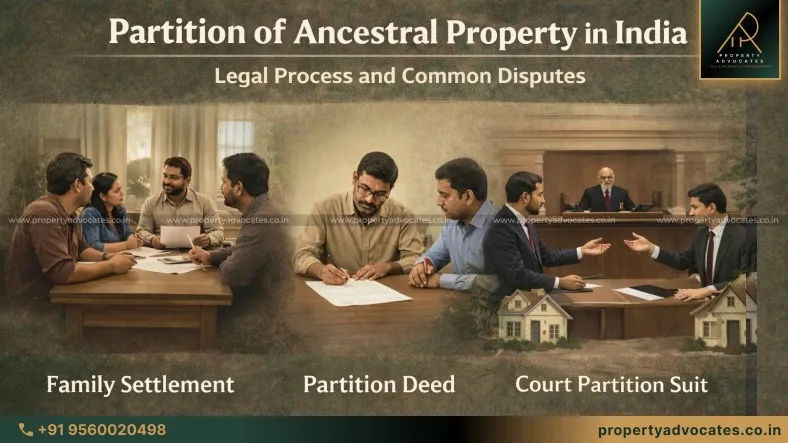
Partition may occur either through mutual agreement within the family or through judicial intervention when disputes arise.
1. Family Settlement
The first and most preferred method of partition is a family settlement, where members agree to divide property amicably.
Family settlements are encouraged by courts because they reduce litigation and preserve family harmony.
The Supreme Court in Kale v. Deputy Director of Consolidation held that family arrangements are legally valid and should be upheld if made to resolve disputes among family members.
2. Partition Deed
Where the parties mutually agree on division, they may execute a partition deed.
A partition deed records:
- Details of the property
- Shares allotted to each coparcener
- Mode of division
Such a document must be registered under the Registration Act, 1908, particularly Section 17, which mandates registration of documents affecting immovable property rights.
Registration ensures legal validity and prevents future disputes.
3. Filing a Partition Suit
If family members cannot agree on division, a coparcener may file a civil suit for partition.
The process generally involves:
- Filing a plaint before the appropriate civil court.
- Establishing genealogy and ownership rights.
- Determination of shares by the court.
- Appointment of a commissioner for the physical division of property.
- Passing of a preliminary decree declaring shares.
- Passing of a final decree implementing actual division.
These procedures are governed by the Code of Civil Procedure, 1908, particularly Order XX Rule 18, which deals with decrees in partition suits.
Types of Partition in Indian Law
Partition may occur in different forms depending on the circumstances.
Physical Partition
This involves the actual division of property, such as dividing land into separate plots among coparceners.
Notional Partition
Notional partition is a legal fiction used for determining the share of a deceased coparcener under succession laws. It assumes that a partition occurred immediately before the death of a coparcener.
This concept is often applied under Section 6 of the Hindu Succession Act to calculate inheritance rights.
Common Disputes in Partition Cases
Partition suits often involve complex disputes that courts must resolve.
Dispute Regarding Nature of Property
One of the most common issues is determining whether property is ancestral or self-acquired.
The Supreme Court clarified this distinction in Yudhishter v. Ashok Kumar, holding that property inherited from a father becomes ancestral only if it remains undivided across generations.
Exclusion of Legal Heirs
Family members are sometimes excluded from property distribution, particularly daughters or widows.
The Supreme Court addressed this issue in Vineeta Sharma, reaffirming that daughters have equal rights in coparcenary property.
Illegal Sale by the Karta
The Karta of a Hindu Undivided Family manages the ancestral property. However, the Karta cannot sell such property arbitrarily.
Sale is valid only if it is for:
- Legal necessity
- Benefit of the estate
- Payment of family debts
This principle was established in Hunooman Persaud Pandey v. Mussumat Babooee Munraj Koonweree, which remains a foundational precedent on the powers of the Karta.
Fraudulent Transfers and Benami Transactions
Partition disputes sometimes involve allegations of fraudulent sale deeds or benami transactions intended to deprive other heirs of their share.
Such transactions may fall under the Benami Transactions (Prohibition) Act, 1988, which prohibits property held in the name of another person for the benefit of the real owner.
Rights of Women in Ancestral Property
The legal status of daughters in ancestral property underwent a significant change after the Hindu Succession (Amendment) Act, 2005.
Before the amendment, daughters were not considered coparceners in many Hindu joint families. The amendment granted daughters equal rights and liabilities as sons in coparcenary property.
The Supreme Court’s decision in Vineeta Sharma clarified that daughters are coparceners by birth, ensuring gender equality in property rights.
Partition of Property Under Other Personal Laws
Partition rules vary depending on personal laws applicable to different communities.
Muslim Law
Muslim law does not recognize the concept of coparcenary. Property devolves only upon the death of a person, and heirs inherit fixed shares according to Islamic inheritance principles.
Christian Law
Inheritance among Christians is governed primarily by the Indian Succession Act, 1925, which regulates succession and property distribution.
Tax Implications of Partition
Partition of property within a Hindu Undivided Family also has tax consequences.
The Income Tax Act, 1961, under Section 171, recognizes partition of an HUF for tax purposes. Once partition is accepted by tax authorities, the HUF ceases to be taxed as a single entity and members are taxed individually on their respective shares.
How Courts Resolve Partition Disputes
When partition suits reach courts, judges evaluate multiple forms of evidence, including:
- Title documents
- Revenue records
- Genealogical charts
- Evidence of possession
- Prior family arrangements
Courts may order physical division of property, appoint commissioners to supervise partition, or in cases where division is impractical, order sale of the property and distribution of proceeds.
Practical Legal Considerations Before Filing a Partition Suit
Before initiating litigation, parties should carefully evaluate several factors.
First, verifying title documents and revenue records is essential to establish ownership rights. Second, parties should consider attempting a family settlement to avoid prolonged litigation. Third, documenting genealogy and historical ownership of the property helps strengthen a legal claim.
Consulting a legal professional before initiating a partition suit can significantly reduce procedural errors and strengthen the case strategy.
CONCLUSION
Partition of ancestral property remains a complex and highly litigated area of Indian civil law. While statutes such as the Hindu Succession Act provide a legal framework for inheritance and coparcenary rights, disputes frequently arise due to unclear property titles, family disagreements, and illegal transfers.
Indian courts, therefore, play a crucial role in interpreting statutory provisions and applying judicial precedents to ensure fair distribution of property.
Understanding the legal process, statutory framework, and relevant case laws can help individuals navigate these disputes effectively and protect their lawful rights.
FAQs
What is ancestral property under Indian law?
Ancestral property is property inherited up to four generations of male lineage from a common ancestor without division, where coparceners acquire rights by birth.
Who can claim a share in ancestral property?
Under the Hindu Succession Act, sons and daughters are coparceners and have equal rights to claim a share in ancestral property.
Can a coparcener sell ancestral property without consent of others?
A coparcener or Karta can sell ancestral property only for legal necessity or benefit of the estate; otherwise, such a sale can be challenged by other coparceners.
How can ancestral property be divided?
It can be divided through a mutual family settlement, a registered partition deed, or by filing a partition suit in a civil court.
Is registration of a partition deed mandatory?
Yes, if the partition deed involves division of immovable property, it must be registered under the Registration Act, 1908 to be legally valid