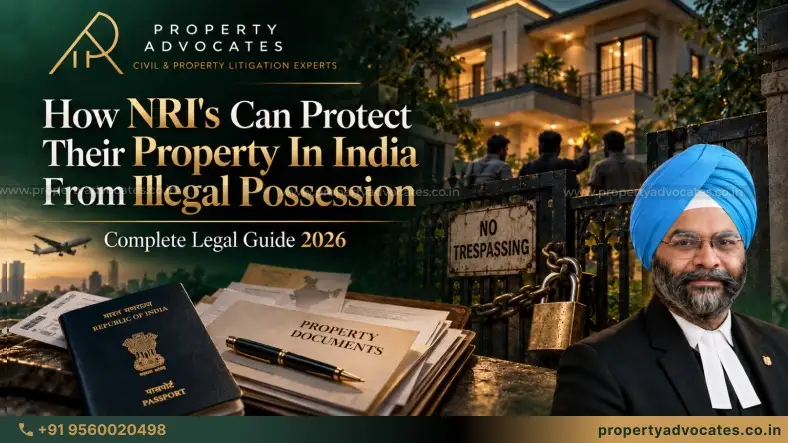
NRI property in India at risk of illegal possession? Learn about adverse possession, GPA, injunctions, trespass, forged documents and recovery remedies in 2026.
NEW DELHI: Living abroad does not weaken your ownership. Ignoring what is happening on your property can.
From caretakers refusing to vacate to forged GPAs, relatives claiming ownership and tenants overstaying, this guide explains how NRIs can protect Indian property before a possession dispute becomes years of litigation.
The Biggest NRI Property Mistake: “Someone I Trust Is Looking After It”
An NRI may own a Delhi flat, a Punjab house, inherited property in Uttar Pradesh or commercial property in Mumbai while living thousands of kilometres away.
That distance creates opportunity for misuse.
A relative starts behaving like an owner. A caretaker refuses to leave. A tenant changes the nature of possession. Someone produces an alleged Agreement to Sell or GPA. A boundary is shifted. A forged document appears. The owner discovers everything only when he decides to sell.
My first rule for NRI property is simple:
Do not manage property through trust alone. Manage it through documents, evidence and regular verification.
The Property Advocates approach is equally simple: title first, possession documented, authority controlled and action immediate.
Does An NRI Lose Property If Someone Occupies It For 12 Years?
No. Twelve years of occupation does not automatically make an illegal occupant the owner.
This is one of the most dangerous property-law myths in India.
Article 65 of the Limitation Act, 1963 prescribes twelve years for a title-based possession suit, but time begins when the defendant’s possession actually becomes adverse to the plaintiff. Section 27 can extinguish the owner’s right when the prescribed limitation period for possession expires.
The Supreme Court in Ravinder Kaur Grewal v. Manjit Kaur, (2019) 8 SCC 729 made the requirement clear. Adverse possession has to be hostile, open, continuous and in denial of the true owner’s title.
The Court specifically observed:
“Trespasser’s long possession is not synonym with adverse possession.”
Mere occupation is not enough.
This distinction becomes extremely important where possession originally began with the owner’s permission.
Can A Caretaker Or Relative Claim Ownership After Living There For Years?
Ordinarily, permissive occupation does not become ownership merely because many years have passed.
In Maria Margarida Sequeira Fernandes v. Erasmo Jack de Sequeira, (2012) 5 SCC 370, the Supreme Court laid down strong principles regarding caretakers and gratuitous occupants.
The principle was reaffirmed by the Delhi High Court as recently as 22 September 2026 in Chandrawati Shah v. Rajinder Kaur, RFA 453/2025, 2026:DHC:8153.
The Delhi High Court reiterated that a person allowed to occupy property gratuitously or as a caretaker does not acquire title merely because the occupation continued for years or decades.
That does not mean an owner should remain silent indefinitely.
Permissive possession should always be documented.
7 Steps Every NRI Property Owner Should Take
- Build a complete title file. Keep the registered Sale Deed, Conveyance Deed, Gift Deed or other title document, previous title chain, mutation/revenue records, property-tax records, sanctioned plans, society records, loan discharge documents and inheritance papers together. Remember: mutation, electricity bills and tax receipts may be evidence, but they do not by themselves replace legal title.
- Create recurring evidence of possession and condition. Have the property physically inspected. Preserve dated photographs, video, correspondence with the occupant, society/RWA records and utility information. For electronic evidence intended for litigation, preserve the original material and comply with applicable requirements of the Bharatiya Sakshya Adhiniyam, 2023, including Section 63 where applicable.
- Never leave a caretaker’s status oral. If somebody is staying only to look after the property, record the arrangement in writing. Clearly identify the property, purpose of occupation, permissive nature of possession, inspection rights, restrictions on transfer/subletting and termination. Stamp and registration requirements must be checked under the law applicable to that State and document.
- Use a narrow Power of Attorney, not a blank cheque. NRIs often need an attorney in India, but the document should grant only the authority actually required. Section 33 of the Registration Act recognises specified powers of attorney executed by persons residing outside India when executed and authenticated before authorities including a Notary Public, Court, Judge, Magistrate, Indian Consul or Vice-Consul. Local stamping/adjudication requirements must also be checked.
- Monitor registration, revenue and litigation records. Periodically check the relevant Sub-Registrar, revenue/land-record authority, municipal records and court records. The exact online system differs from State to State. A forged or competing transaction discovered early is far easier to attack than one discovered after subsequent transfers.
- Keep tenants and licensees on proper documentation. Do not create indefinite oral arrangements. Record rent/licence, term, deposit, permitted use, renewal, notice and termination. Rent-control laws differ between States, and some tenancies fall under special rent legislation while others are governed substantially by the Transfer of Property Act.
- Act on the first serious red flag. Changed locks, construction, refusal of inspection, claims of ownership, forged papers, attempted sale or sudden denial of your title should not be ignored. Preserve evidence and determine immediately whether the case requires a notice, injunction, possession suit, declaration/cancellation proceedings or criminal complaint.
A GPA Is Authority. It Is Not Ownership.
This is particularly important for NRIs because property is frequently managed through relatives or attorneys.
Section 54 of the Transfer of Property Act states that a sale of qualifying immovable property is made through a registered instrument, and a contract for sale does not by itself create an interest or charge in the property.
The Supreme Court again examined this issue in Ramesh Chand (D) Through LRs v. Suresh Chand & Anr., 2025 INSC 1059.
Its formulation was direct:
“A power of attorney is not a sale.”
A genuine GPA may authorise another person to act. It does not itself become a Sale Deed.
For an NRI, that means:
Give authority where necessary. Do not casually give ownership-like control.
What If The Property Has Already Been Illegally Occupied?
The remedy depends on what actually happened.
| Situation | Possible Legal Remedy |
| Recently dispossessed without consent or due process | Section 6, Specific Relief Act |
| Owner has title but has lost possession | Regular suit for recovery of possession |
| Occupant has created a competing title claim | Declaration + possession + injunction, depending on facts |
| Forged Sale Deed/GPA/document appears | Appropriate civil challenge plus criminal remedies where ingredients are established |
| Sale, construction or third-party transfer is threatened | Temporary/permanent injunction |
| Criminal entry/trespass with statutory intent | BNS criminal remedies may apply |
| Occupant continues after termination | Appropriate eviction/possession proceedings depending on nature of occupation |
Section 6 Specific Relief Act: The Six-Month Emergency Window
Section 6 provides a special summary remedy where a person has been dispossessed without consent otherwise than through due course of law.
The critical deadline is six months from dispossession.
This remedy focuses primarily on prior possession and illegal dispossession rather than finally deciding ownership.
A 2026 Bombay High Court judgment, Jayashree Jaisingh Babar v. Shirish Ramdas Sarode, 2026:BHC-AS:7700, again discussed the limited, summary character of Section 6 proceedings.
Injunction, Possession Or Declaration: File The Correct Case
A badly framed property suit can waste years.
The Supreme Court explained the distinction in Anathula Sudhakar v. P. Buchi Reddy, (2008) 4 SCC 594.
Broadly:
If you are in lawful possession and someone merely threatens interference, an injunction may be sufficient.
If you are out of possession, you normally need to seek possession.
If your title itself has come under a genuine cloud and you are also out of possession, declaration, possession and consequential relief may be required.
Do not file an injunction-only case when your real dispute is about ownership and recovery of possession.
Can The NRI Simply Remove The Illegal Occupant By Force?
This is where owners often damage their own cases.
Even a true owner should not assume that ownership gives an unlimited right to use force against somebody already in settled possession.
In Rame Gowda v. M. Varadappa Naidu, (2004) 1 SCC 769, the Supreme Court explained that where a trespasser has acquired settled possession, the true owner must recover possession through law rather than take the law into his own hands.
So the strategy is not:
“It is my property, I can throw him out.”
The correct strategy is:
“It is my property. I will obtain an enforceable legal order and take it back.”
When Does Illegal Possession Become A Criminal Matter?
Not every property dispute is automatically a criminal case.
Under Section 329 of the Bharatiya Nyaya Sanhita, 2023, criminal trespass requires entry into or unlawful remaining upon property in another’s possession with specified intent, such as intent to commit an offence or to intimidate, insult or annoy the person in possession.
Where fabricated property documents are involved, Sections 335 and 336 BNS deal with making false documents and forgery. Section 340 concerns use of a forged document as genuine. Cheating may attract Section 318 BNS where its statutory ingredients are established.
A civil dispute should not be artificially converted into a criminal complaint.
But equally, genuine forgery, cheating or criminal trespass should not be dismissed merely by calling everything a “civil dispute”.
Facts decide the remedy.
Can An NRI Fight A Property Case Through Power Of Attorney?
To a substantial extent, yes.
Order III Rules 1 and 2 CPC recognise appearances and acts through recognised agents, including persons holding appropriate powers of attorney. The Court can, however, require personal appearance where legally necessary.
There is another important limitation.
In Janki Vashdeo Bhojwani v. IndusInd Bank Ltd., (2005) 2 SCC 217, the Supreme Court held that a Power of Attorney holder cannot simply enter the witness box and give evidence about matters that were exclusively within the principal’s personal knowledge.
The attorney can testify about transactions or acts personally handled or known by him.
For NRIs this means:
Use a POA to manage litigation. Do not assume a POA can manufacture personal knowledge.
NRI Property Ownership And FEMA: One Important Reminder
Under the RBI’s current FEMA framework, including the Foreign Exchange Management (Non-Debt Instruments) Rules, 2019, an NRI or OCI can generally purchase immovable property in India other than agricultural land, plantation property or a farmhouse, subject to the applicable rules.
Inheritance has separate treatment, including the ability of an NRI/OCI to inherit immovable property in circumstances permitted by FEMA.
Therefore, property-protection strategy should also check whether the original acquisition, inheritance or transfer complies with FEMA and other applicable law.
What Indian Courts Have Actually Said
These are judicial observations, not reconstructed courtroom dialogue.
Supreme Court, Ravinder Kaur Grewal:
“Trespasser’s long possession is not synonym with adverse possession.”
Supreme Court, Ramesh Chand:
“A power of attorney is not a sale.”
Supreme Court principle applied again by Delhi HC in 2026:
A caretaker or gratuitous occupant does not acquire title merely because occupation continued for years.
That is the legal position NRIs should remember.
My Advice To NRIs
The problem is usually not that the owner lives in London, Dubai, Canada, Australia or the United States.
The problem begins when nobody in India is legally documenting what is happening to the property.
A ₹5 crore property should not be supervised through occasional WhatsApp messages to a relative.
Keep the title clean.
Keep the occupant’s status written.
Keep your Power of Attorney narrow.
Keep checking the records.
And the moment somebody starts behaving like the owner of your property, stop treating it as a family misunderstanding.
In property litigation, delay gives the other side evidence, possession and leverage.
FAQ’s
1. Can a caretaker become owner after 12 years?
Not merely by staying for 12 years. Adverse possession requires hostile, open and continuous possession satisfying strict legal requirements. Permissive possession does not automatically become adverse possession.
2. Can an NRI recover property without personally coming to India?
Often, substantial proceedings can be managed through advocates and a properly authorised Power of Attorney holder. However, the Court may require the NRI’s personal participation or evidence where facts are within the NRI’s exclusive knowledge.
3. Can police remove an illegal occupant from NRI property?
Not simply because ownership is disputed. Police can act where a cognizable criminal offence is made out. Recovery of possession or determination of title generally requires the appropriate civil remedy.
4. Does mutation prove that a person owns the property?
No. Mutation and revenue entries may be relevant evidence and are important for records, but ownership must ultimately be examined through the legally valid title chain and applicable law.
5. Can an NRI sell Indian property only through a GPA?
A GPA can authorise an attorney to execute authorised acts, including a conveyance where lawfully empowered. But the GPA itself is not the sale. Ownership through sale requires the legally required conveyance.